Ashoka Halwa (Mung Bean Pudding)

Introduction
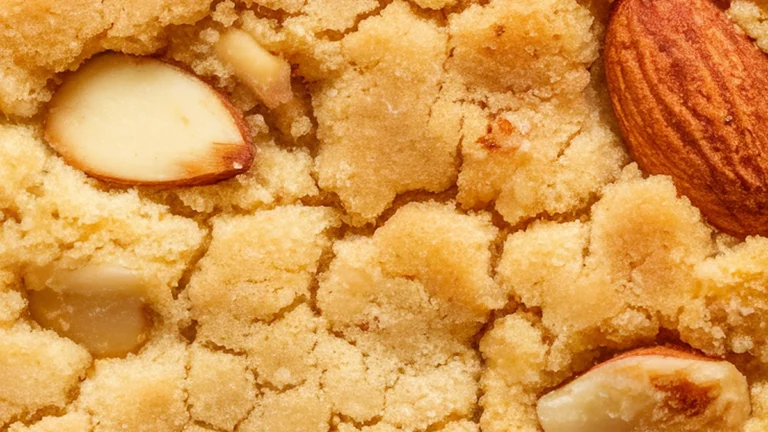
Ashoka halwa is a dense, fudgy mung bean pudding thickened with ghee and wheat flour until it pulls away from the pan as a single mass. The roasted moong dal gives it a subtle nutty depth, while cardamom and fried cashews add warmth and texture. This recipe yields a rich, spoonable dessert that keeps for days.
Recipe Details
- Prep Time: 10 minutes
- Cook Time: 40 minutes
- Total Time: 50 minutes
- Servings: 4
Ingredients
- 1 cup split yellow moong dal
- 3 cups water
- 2 cups granulated sugar
- 12 tablespoons ghee, divided
- 4 tablespoons wheat flour
- ¼ teaspoon cardamom powder
- 3 tablespoons broken cashews
- 1 pinch red food colouring in 1 teaspoon water
Instructions
- Dry roast the moong dal until it smells nutty and browns slightly.
- Add 3 cups of water and pressure cook for about 7-8 whistles until the dal is soft and mushy.
- Add 4 tablespoons ghee to a heavy-bottomed pot over medium-low heat, and cook the wheat flour in it until golden brown.
- Stir the cooked dal into the flour mixture, and let it thicken for 5 minutes. Add the sugar.
- Stirring continuously, start mixing in the remaining ghee 1 tablespoon at a time. Keep stirring until the mixture starts leaving the sides of the pan and the whole mixture forms a dough. It will take about 12-15 minutes and 6-7 tablespoons of ghee.
- Heat 1 tablespoon of ghee in a separate frying pan, and add the cashews. Fry until slightly brown, then add to the halwa mixture.
- Mix in the powdered cardamom and food color.
- Remove from the heat and let cool.
Variations
Omit the red food coloring for a natural pale golden finish; the halwa’s color will come entirely from the roasted dal and browned flour.
Add 2 tablespoons of chopped pistachios alongside the cashews for a contrast of flavors and a slight textural change.
Replace ¼ teaspoon of the cardamom powder with ⅛ teaspoon of cardamom powder plus ⅛ teaspoon of ground ginger for a warmer, slightly spiced note.
Stir in 2 tablespoons of unsweetened shredded coconut after the cashews for a subtle coconut undertone and added texture.
Use 1 tablespoon of ghee infused with a few saffron strands (warmed together) in place of the final 1 tablespoon of plain ghee to add a floral, golden quality.
Tips for Success
Roast the moong dal until it browns noticeably and releases a toasted aroma; this step builds the halwa’s depth and prevents a raw, chalky taste.
Use a heavy-bottomed pot to prevent the mixture from burning on the bottom during the long stirring phase; a thin-bottomed pan will create hot spots and scorch the halwa.
If the halwa becomes too stiff before all the ghee is incorporated, reduce the heat slightly; the mixture should remain workable and glossy, not dry or crumbly.
Let the halwa cool completely in the pot before serving or storing; it will firm up further as it cools and will slice or scoop cleanly.
Storage and Reheating
Store the cooled halwa in an airtight container at room temperature for up to 5 days, or in the refrigerator for up to 10 days. It does not freeze well; freezing breaks down the smooth, dense texture.
To reheat, place a portion in a small bowl and warm gently in the microwave in 15-second intervals, stirring between pulses, until it reaches your preferred temperature. Alternatively, warm it gently in a small pot over low heat with a splash of milk if it has dried out slightly.
FAQ
Can I make this without a pressure cooker?
Yes. Boil the roasted moong dal in 3 cups of water in a regular pot for 25–30 minutes, stirring occasionally, until it breaks down into a soft, mushy consistency. Proceed with the recipe as written.
Why does my halwa look grainy or separate rather than smooth?
Graininess usually means the dal was not pressure-cooked long enough or broken down fully; aim for a very soft, almost paste-like texture before adding to the flour. Separation (ghee pooling on top) can happen if you add ghee too quickly; slow down and stir longer between additions.
Can I reduce the sugar?
What if I don’t have cardamom powder?
Crush 4–5 green cardamom pods in a mortar and pestle to release the seeds, then grind them as finely as you can. Use the same ¼ teaspoon quantity. Alternatively, omit it entirely for a neutral, nutty-sweet halwa.
Attribution: Recipe text from “Cookbook:Ashoka Halwa (Mung Bean Pudding)” on Wikibooks (© Wikibooks contributors).
Source: https://en.wikibooks.org/wiki/Cookbook:Ashoka_Halwa_(Mung_Bean_Pudding)
License: CC BY-SA 4.0 — https://creativecommons.org/licenses/by-sa/4.0/
Additions: Editorial additions and formatting changes were made for clarity and usability. Ingredients, instructions, and other sections may be adapted where appropriate.